























Tom Lamont and Going Home
Tom Lamont, a British journalist, published his first novel, Going Home, in England in 2024; it came out in the United States in January of this year. Lamont has been an award-winning journalist for a number of years, publishing often in The Observer and The Guardian. He has also been a regular correspondent for the US magazine GQ, since 2017. At The Guardian, he helped found the Long Read desk, a podcast and weekly email column that cover a wide range of subjects: business, politics, money, internet culture, modern life, war, climate change, and music. Lamont has been called “the interviewer of choice” for Adele and Harry Styles, having written early, in depth articles on both writers. Today Lamont lives in north London with his wife, son, and daughter.
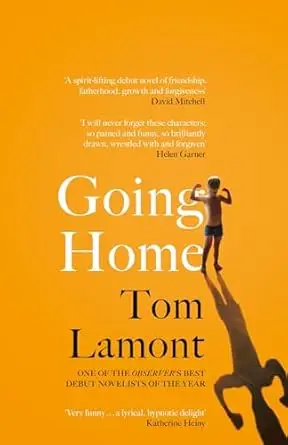
Going Home features many autobiographical elements. Like the main character of the novel, Téo Erskine, Lamont is half Jewish. His father was a lapsed Catholic from rural Scotland while his mother is Jewish. Like his fictional character, Lamont grew up in a Jewish enclave in north London. He has said of that experience, “I was bar mistzvahed; I went to Hebrew classes. My family have been less faithful as I’ve got older but I learned about humour, food and love through the prism of Jewishness.”
Téos father in Home, Vic Erskine, is closely based on his father John Lamont; Tom Lamont began writing the novel during the time when his father was dying of a Parkinson’s-like disease. In June 2024, Lamont published an article, “My dad’s unimaginable life and death and the novel I wrote about his death,” in The London Times. He tells that he had completed Chapter 10 of the novel on the day before his father died. Lamont says that he continued to write the novel while grieving for his father, finding both relief in the work and a sense of guilt for almost capitalizing on his father’s end. Vic Erskine’s horrific family background in Going Home directly mirrors that of John Lamont, whose mother had four children and no husband. When her house burned, the children were separated and dispersed. John Lamont spent his childhood in an oppressive orphanage. The fictional Vic Erskine experiences an identical fate
John Self, reviewing Going Home in The Guardian declares that the novel has “has charm to burn.” The novel opens with a stream-of-consciousness section inside the head of two-year-old Joel, a charming child who serves to unite the three major male characters of the novel. The father of a young son himself, Lamont creates a realistic child, full of imagination, just on the verge of becoming vocal. Lamont’s other characters are equally fascinating as they interact in assuming responsibility for Joel when his troubled mother, Lia Woods, commits suicide after leaving her son in Téo’s care.
Lamont’s treatment of Enfield, the Jewish community where Téo grew up also has its own charm. Lamont captures the nostalgia that many of us hold from our teenage years, especially our continued attachment to friends from youth. Téo has tried to disconnect from Enfield by moving into the heart of London to work, but his attachment to his friends and father draw him home.
Within its 287 pages, Lamont covers a number of universal themes, all deftly handled with sincerity and almost no sentimentality. He covers the human need for love and family and, especially, the power of a child to evoke love; he treats the vagaries of aging–the movement toward death; he also examines the strength of long-time friendships even when friends—like Téo Erskine and Ben Mossam–are so different. Through Lia’s suicide, Lamont analyzes the inability of some to adapt to the realities of human existence. Isaac Fitzgerald, writing in The New York Times praises “Lamont’s human, heartfelt and nonjudgmental portrait of depression and suicide,” presented through Sybil Chassis, the Jewish rabbi, who assigns blame for Lia’s death to those around her who failed to help. Through Sybil, as the first female Rabbi in a traditional Jewish community, Lamont offers a new perspective on Judaism in the modern world. Darren Richman writes “Judaism . . . is one of the novel’s key components. The push and pull of tradition and making your own way is at the heart of both the book and the psyche of many Jews.”
Téo, his father, Vic and Téo’s closest friend Ben Mossam are the three male character who are forced to assume responsibility for Joel after Lia’s death. She has deliberately left the child with Téo, knowing that he loves her and that he is more responsible than anyone else she knows. Ben, who comes from a wealthy background, has never had to consider anybody other than himself. Like Lia and Téo, he is also Jewish. He always wears a yarmulke, but not as a sign of belief, only as proof of his genetic superiority. In the Erskine household, Joel’s arrival allows the dying Vic one last opportunity to act as a loving father. Joel, unaware of his illness, treats Vic the same way he does the other adults around him—as a playmate.
Darren Richman correctly asserts that Lamont, in that Going Home, incorporates “curiosity and compassion for human beings” while also interrogating their motives. The novel, well-written and direct, combines serious content with humor and understated commentary on modern life.