




















Why the tools you use don’t determine your integrity as a craftsperson
This month, I’m sharing something a bit different from my usual memoir pieces—an essay I originally wrote for fellow craftspeople about the nature of quality work and what it means to ‘cheat’ in any craft or profession. While it draws from my experiences as a blacksmith, the lessons about honest work and meeting expectations apply far beyond the forge. I hope you’ll find these reflections on craftsmanship relevant to whatever work you do with your hands or heart.
“You can do better than this.” Those words hit me like a hammer blow. It was 2013, and I had just finished showing off a decorative grille I’d made for the little octagonal window in our Victorian home’s bathroom. At the local blacksmith club meeting, several colleagues had praised my design. I felt pretty good about myself—until Dale, a friend and mentor, approached me with that unmistakable look of disappointment.
He was right, and I knew it. I hadn’t done my best work. The electric welder marks on the back weren’t even concealed. The scrollwork was hastily contrived, looking decent from a distance but sloppy up close. For some reason, I thought I didn’t need to spend the time to do the job right because it was for my own home. I would never have dreamed of delivering such poor workmanship to a paying client.
I had cheated myself.
Dale’s criticism stuck with me, and to this day I hear his voice whenever I’m tempted to cut corners. But it took me another decade to truly understand what separates legitimate craftsmanship from actual cheating—and it has nothing to do with whether you use a power hammer or hand forge.
The Purist’s Dilemma
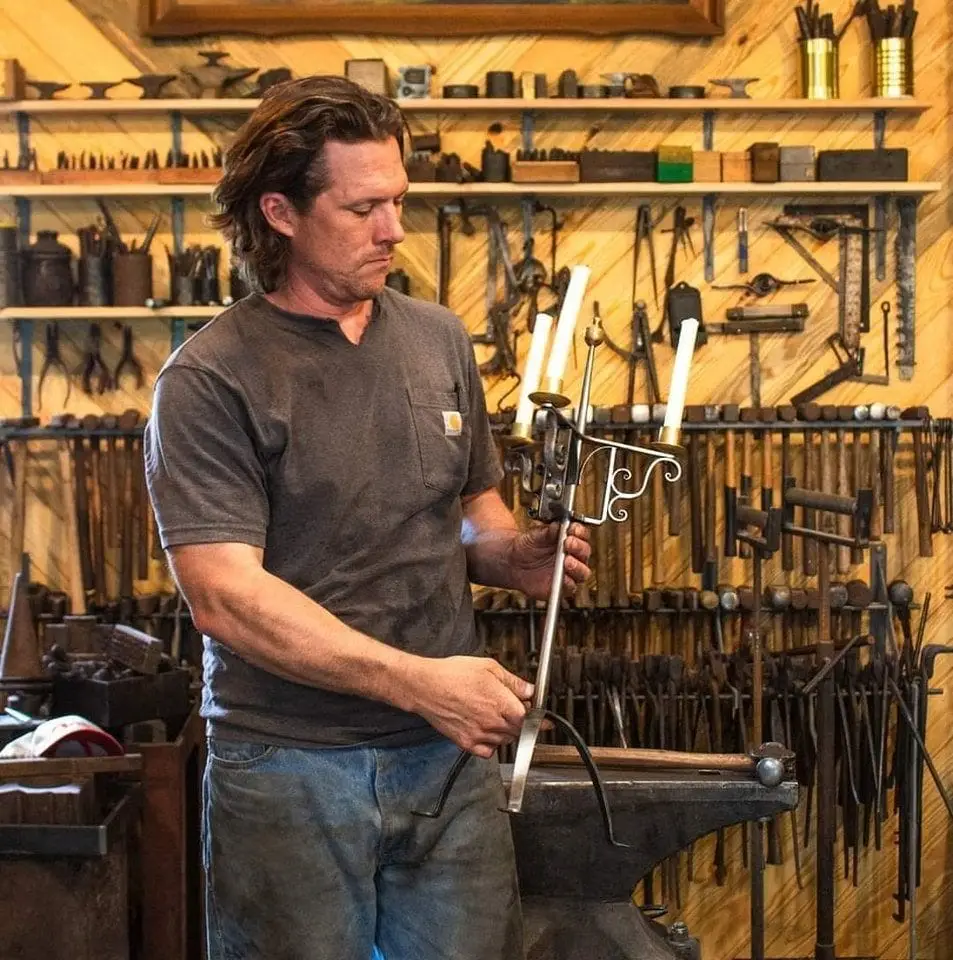
I’ve lost count of how many times I’ve heard “but that’s cheating” from well-intentioned blacksmiths who defend a purist idea of craft as the only standard of excellence. The threshold varies by critic. For some, any power tool is forbidden—the power hammer, drill press, grinder, and electric welder are off-limits. Heavy iron must be forged with a striker, holes must be hand-punched, rough edges smoothed with a file, and only forge welding is permitted.
While I understood this common criticism as well-intentioned, it always felt off base. This dilemma isn’t unique to blacksmithing—woodworkers, leatherworkers, and other craftspeople face similar purist pressures. But what if we’re asking the wrong questions entirely?
A Library’s Lesson
In 2023, I lost a close friend and mentor. Among the treasures I inherited was his extensive library—so many volumes that I had to quickly decide what to take. My strategy was simple: grab the books that showed the most love. The more dog-eared pages, bookmarks, sticky notes, and underlined passages, the better.
One book stood out above all others as the most cherished in the entire collection. Its pages were filled with annotations; its spine creased from countless readings. This was The Nature and Art of Workmanship by David Pye, and it would revolutionize how I think about craft.
Pye’s insight hit me like Dale’s criticism had years earlier, but this time it illuminated rather than stung:
The goodness or badness of workmanship is judged by two different criteria: soundness and comeliness. Soundness implies the ability to transmit and resist forces as the designer intended; there must be no hidden flaws or weak places. Comeliness implies the ability to give that aesthetic expression which the designer intended, or to add to it. Thus, the quality of workmanship is judged in either case by reference to the designer’s intention, just as the quality of an instrumentalist’s playing is judged by reference to the composer’s… Good workmanship is that which carries out or improves upon the intended design.
(Pye, David. The Nature and Art of Workmanship. 1st ed., vol. 1, Cambridge University Press, 1968. p. 13)
Here was my answer. The measure of cheating isn’t about tools or techniques—it’s about intention and execution.
What Is Cheating, Really?
If you look up “cheating” in any dictionary, you’ll find it defined as behaving dishonestly or unfairly to gain advantage or avoid hardship. Cheating is deceitful. It robs someone of value.
So, when performing your craft, ask yourself: Are you robbing yourself or your client of value? Are you presenting your work as something it’s not? Are you cutting corners out of fear rather than design requirements?
If the answer to any of these is yes, then cheating might be in play. But notice what’s not in this definition: the specific tools or methods you use.
A Framework for Honest Craftsmanship
After two years of pondering Pye’s wisdom, I’ve developed a framework that guides my work. These principles are written boldly on my shop walls, serving as daily reminders that good workmanship flows from clear intention and honest execution.
Do Hard Things When They Matter
One definition of cheating is “the avoidance of something undesirable.” If I choose the easy path because I’m afraid of difficulty—not because the design calls for efficiency—then I’m cheating myself out of growth and cheating my client out of excellence.
The key is setting proper expectations before starting any project. Ask the right questions: Does the client want traditional methods? Is budget the primary concern? Is this piece meant for heavy use where function trumps form?
Use these answers to create a design that serves as your roadmap. If the client-led design calls for hand-punched holes, then drilling would betray their expectations. If they want forge welding, then forge weld. Learn to do hard things when required, but don’t feel ashamed of modern methods when the design allows for them.
Never Cut Corners—You Never Know Who’s Watching
Most of my new clients come from personal referrals. I can trace one job from over a decade ago—a project I almost didn’t take because I was intimidated and barely made any money on it—to about half a dozen subsequent jobs worth tens of thousands of dollars.
Because I didn’t cut corners and met the design expectations we’d agreed upon, I earned a raving review. If I had compromised to save time, I would have damaged my reputation and lost a decade of high-quality referrals. Every piece you make is a potential advertisement for your character as a craftsperson.
Traditional Methods Aren’t Inherently Superior
I believe every good craftsperson should learn traditional methods—they’re the fundamental building blocks that inform modern techniques. But using traditional methods doesn’t make you more virtuous, nor does using modern methods indicate less skill or character.
The determination of which method to use should flow from your design. If engineering or cost considerations call for an electric weld, use it. If client expectations call for forge welding, forge weld. Traditional techniques aren’t inherently better, nor are modern techniques inherently worse.
The question isn’t “What would the old masters do?” but “What’s the best application of my skills for this specific task?”
The Real Question
The next time someone says “but that’s cheating,” respond with this: “Who am I cheating?”
Are you cheating the client by misrepresenting your work or cutting corners they didn’t approve? Are you cheating yourself by avoiding growth or compromising your standards? Are you betraying your character as a craftsperson?
If the answer is no, then carry on. Remember that budget, application, engineering, and design all inform which techniques are appropriate. You must decide which jobs align with your values and capabilities.
If you choose to specialize in traditional methods as part of your brand, that’s admirable—many skilled craftspeople distinguish themselves through adherence to historical techniques. But that doesn’t make them more virtuous than those who embrace modern tools.
The real questions are: What does your target clientele want? Can you deliver excellence within their parameters? Can you maintain your standards while still paying your bills?
Excellence isn’t about the tools you use—it’s about honestly fulfilling the promise you make with every piece you create. That’s the difference between craftsmanship and cheating.
***If you enjoyed this article, you can find more of Drew’s essays on craft by following his blog “This Forged Life” on Substack @drewtalexander***