

















Two Novels about John Brown: Russell Banks, Cloudsplitter and James McBride, The Good Lord Bird
John Brown remains a controversial figure in U.S. history, considered villain or hero depending on point of view. There’s no doubt, however, that his 1859 attack on Harper’s Ferry was a pivotal impetus to the Civil War. Both Brown’s bold attack and his plan to recruit an army of American Blacks were frightening to North and South. . Since that attack and his subsequent hanging, numerous writers have tried to capture Smith’s audacity in thinking that he and his small army could end slavery. Almost immediately, Henry David Thoreau wrote a “A Plea for Captain John Brown,” an essay defending Brown’s actions and arguing that violence was a necessary response to slavery.
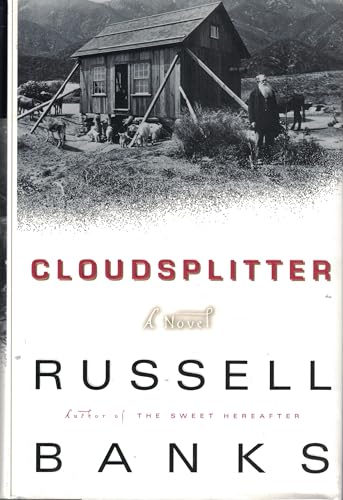
Since then, historians have produced many studies of Brown. Both Frederick Douglass and W. E. B. Du Bois produced biographies early in the 20th century; more recently, outstanding studies have been written by Steven Oates, David S. Reynolds, and (most recently) Tony Horwitz. Novelists have also been fascinated with John Brown; two of them are Russell Banks and James McBride. Russell’s novel, Cloudsplitter came out in 1998 and McBride’s The Good Lord Bird in 2013.
The two novels couldn’t be more different, though both feature first-person narrators. Owen, Brown’s third son is the narrator of Banks’s book. The real-life Owen was Brown’s only son to survive the Harper’s Ferry attack. In both history and in Banks’s novel, Owen, left to guard the band’s stash of supplies, is able to make his escape. Banks sets up Owen’s narration by having him visited by a young journalist, who hopes to record his story. In the novel the elderly Owen, writes “letters” to this young woman, ostensibly an assistant to an actual descendent of William Lloyd Garrison. Owen/s narrative shows him as a troubled by guilt and self pity. One reviewer calls him “a muddled and unsympathetic creation whose voice is not adequate to his father’s epic story.”
McBride’s narrator, on the other hand, is a totally fictional character, a young boy, Henry Shackleton, who Brown’s mistakenly identifies as a girl when he and his gang get involved in a brawl in a Kansas tavern. Brown takes in Henry, the son of a slave killed during the episode. Shortly after being taken, Henry eats Brown’s lucky onion and acquires the nickname, “Little Onion” along with a female identity.
The fictional Henry’s narrative comes to light after a Black church in Wilmington, DE burned in 1966; the manuscript turns up in a surviving wall. Henry Shackleton supposedly gave his account to a church member in 1942. Using this young Black narrator, lets McBride show Brown from an entirely different perspective. Onion’s attitude toward Brown seems realistic. He understands the religious impetus behind Brown’s desire to free the slaves, but also sees him as an unsavory character—dirty and unkempt, dictatorial and stubborn, and, in the end, insane.
Both authors give Owen, a central character in both novels, similar qualities. Russell’s Owen, loves and fears his father but lacks John Brown’s religious fervor. He is against slavery, but it is his utter loyalty to his father that keeps him in the band. As was actually true, both Russell and McBride have Brown’s two older sons abandon the mission, remaining in Kansas when the army turns East. Owen is dubious about the possible success of his father’s plan in both novels, expressing clear doubt in Russell’s tale and skepticism in McBride’s novel.
The scope of the two novels is quite different. Russell, who lived in upstate New York near the John Brown farm, now a museum, begins his novel in that area where John Brown, farmer and tanner, is part of the early abolitionist movement, helping slaves escape along the Underground Railroad. Russell’s Brown becomes more radical after the passage of the Fugitive Slave Act. By this time, in Banks’s telling, the older Brown sons have moved to Kansas. John and his other sons join them there and begin their journey of extreme religiosity and shocking brutality.
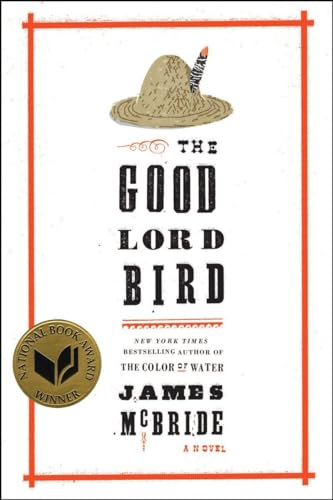
McBride’s novel begins in Kansas with Onion’s capture. The boy is an unwilling witness to the Browns’ violence., and, in some ways, McBride’s novel is as much Onion’s story of movement toward maturity as of John Brown’s drift toward martyrdom. Onion rides with the gang, often appalled by their behavior and bored by Brown’s constant sermonizing. At one point, he spends two years separated from the gang during which he falls in love with a prostitute and witnesses heroic acts by slaves trying to rebel against the egregious system.
Brown’s son Fred appears in both novels; actually part of Brown’s Pottawatomie Massacre, Fred died in 1856 during the Battle of Osawatomie. Banks presents his fictional Fred as a sexual deviant who ends up killed by free-staters. McBride’s Fred is a harmless fellow of limited intellect who befriends Onion in his early days with the Browns. In McBride’s telling, Fred loves nature and has a special affection for an exotic bird that the family calls “the good lord” bird.” McBride’s Fred ominously finds a dead “good lord bird” shortly before he is shot.
Both novels feature John Brown’s interaction with real historical figures including Frederick Douglass and Harriett Tubman. Banks treats Douglass as a heroic figure, but both novelists note his failure to join Brown at Harper’s Ferry. McBride presents an unflattering version of Douglass, portraying him as a drinker and womanizer, thus offering a different perspective on one of the first African American heroes. Overall, both novels offer fascinating interpretations of John Brown, one of the most significant—and outrageous—men in US history. Banks’ portrayal is serious and factual while McBride bends facts and even adds humor to Brown’s story.