























Jonas Hassen Khemiri and The Sisters
Khermiri, a Swedish author, has had great success in his home country where he has published six novels, seven plays and a collection of short stories, essays and plays.
Translated into more than 35 languages, his work has received numerous awards. His first play, Invasion! won a Village Voice Obie award in 2011; acting companies have performed his plays on stages in Stockholm, Berlin, New York and London.
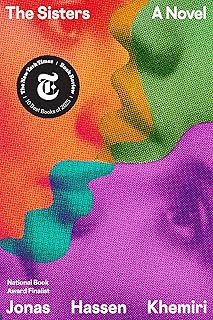
In 2020, his novel The Family Clause was named a finalist for the National Book Award in the US. Awarded a fellowship at the New York Public Library in 2021, Khemiri moved his family to New York City where he is on the Creative Writing Faculty at New York University. In 2023 he was a Visiting Writer at Bennington College and in 2025 at the University of Illinois. His current novel, The Sisters, long listed for the 2025 National Book Award, was named one of the best novels of the year by The New York Times, The New Yorker, and The ChicagoTimes.
Khemiri comes from a mixed ethnic background: his father was Tunisian and his mother Swedish. Growing up as a sort of exotic outsider in Stockholm gave him considerable insight into the universality of racial prejudice. After completing his secondary education in Stockholm, Khemiri studied literature at Stockholm University and international economics at the Stockholm School of Economics. At one point he was also an intern at the United Nations in New York, but his main aim was always to become a successful writer.
This success came early with the publication of his first novel in 2003; One Red Eye sold over 200,000 copies in Sweden, received the award for being the best literary debut of that year, and became a successful movie in 2007. His second novel Montecore received rave reviews and was a finalist for the August Award, the most prestigious award for fiction in Sweden. After the novel was translated into English and published by Knopf in the US, a The New York Times reviewer described it as “funny, ambitious and inventive.” Since then, Khemiri has written three more novels, including Everything I Don’t Remember (2015) that won the August Prize for fiction. US novelist, Joyce Carol Oates, declared that novel one of her three favorite books from 2016.
The Sisters was the first novel Khemiri wrote in English; for publication in Sweden, he translated it into Swedish. He has said that translating the novel helped him improve it. He later re-translated The Sisters for publication in the United States, where Farrar, Straus, and Giroux published it last year.
The Sisters is a combination of fact and fiction. As the title indicates, Khemini tells the intriguing story of the Mikkola sisters who share Khemiri’s mixed racial identity. Besides telling their story, The Sisters also contains much autobiographical material—Khemini even calls his narrator Jonas Khemiri and, in fact, told an interviewer, “Every other chapter was based on a personal memory that I’ve tried to let go of.”
A central character in the novel is the narrator’s father, who, like Khemini’s actual father, left his family when his daughters were in their teens. The writer’s father was an overbearing man who constantly demeaned his sons. When Khemin’s mother divorced him, his father “cursed me and my brothers: ‘Your mother will never be able to raise three boys on her own,’ he said. ‘You will end up homeless drug addicts.’” The Khemiri brothers proved him wrong: Jonas became a writer, his middle brother a successful actor, and his youngest, a psychiatrist. Like his double in the novel, Khemini’s father died just after his son finished The Sisters. Last year, Khemirii published an essay in The Guardian about the extraordinary impact his father had on his life both in his living and in his dying.
The novel, then, is a much about the narrator’s struggle to deal with his troubles as it is about the sisters whom he met about the time of his father’s departure from his family. He (the narrator) develops a life-long obsession with these women whose family history is as troubled as his own. Their mother is Tunisian rug dealer and their father a Swedish failure who dies early. Afterward, the highly- ambitious mother, displaced from her native environment, develops mental problems, including an obsessive belief that her family lives under an unbreakable curse.
Although all three daughters try to ignore their mother’s troubles and the family curse, each is severely damaged Ina, Evelyn, and Anastasia, often left alone, pretty much raise themselves. Ina, the eldest, is a chronic organizer and caretaker. Extremely tall and somewhat ungainly, she is a basketball player who briefly plays for a US college team. She marries and has children but lacks confidence in both her social skills and in her marriage. Evelyn, the middle daughter is the beauty of the three—seemingly extroverted and socially adept, she suffers beneath superficial success. The youngest daughter Anastasia, struggles most openly with the family troubles, using alcohol and drugs to mask her pain.
Khemini organized the 638-page novel into seven books, covering the years between 2000 and 2035, with each book covering less time—Book 1 covers a year, Book 7 covers one minute; he divides these books into 137 chapters which alternate between the narrator’s personal reminiscences and the almost omniscient narrative of the sisters’ lives. Despite its experimental qualities, the novel is not confusing—just a bit too long. Critics have given the novel high praise. A reviewer for The New York Times aptly summarizes: “Jonas Hassen Kemirri plays with time, belonging, and his own insecurities in a big, impressive novel that revolves around a trio of magnetic Swedish women.”