






















Virginia Evans and The Correspondent
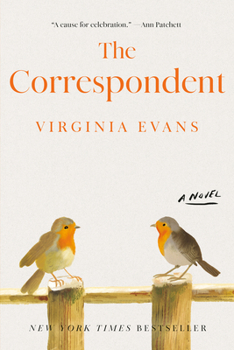
Currently a New York Times best seller and book club favorite, The Correspondent is the work of Virginia Evans (nee Virginia Ficker), who graduated from JMU in 2008. Having majored in English, she, in her Acknowledgements at the end of the novel, thanks two of her professors, Inman Majors and the late Dr. Joan Frederick.
Evans says that she wrote her first novel when she was nineteen. She has since written a total of nine; after two of them were rejected for publication in 2010s, she enrolled in an MA program at Trinity University, Dublin, Ireland, earning an MPhil degree. Today she lives in Winston-Salem, NC with her husband and two children.
The Correspondent is an extraordinary novel, one with special appeal to people over 70. Despite her relatively young age—Evans is 39–, she has created a totally believable retired women, Sybil Stone Van Antwerp, who ages from 73 forward over eight years. Evans actually met an elderly woman whose image gave her the physical presence of Sybil, a woman outwardly strong and independent, but troubled within.
Sybil began her life like many women who grew up in the 1950s. Married with three children, she was also a lawyer who spent her entire career as a clerk for a prominent Washington, DC, judge. Always dedicated to her work, she became even more obsessed after the accidental death of her second son, eight-year-old Gilbert. Left with enormous grief and guilt, Sybil destroyed her marriage and created strained relationships with her surviving children, Bruce and Fiona. Long divorced by 1973, she lives alone in a small Maryland town, has casual friends, a Garden Club membership, sporadic contact with neighbors, and her correspondence.
Sybil’s main connection with life, then, comes through her letters, written, sent and unsent, and from those she receives. Like the original first formal novel, Samuel Richardson’s Pamela (1740), The Correspondent is an epistolary novel. In Evans’s revamping, letters and emails structure the book.
Rather withdrawn, even abrasive with others, Sybil is humanly open in her letters, particularly those to her brother, Felix, in France; to long-time best friend, Rosalie, in Connecticut; and, to Harry, the troubled son of another Washington, DC judge. Harry becomes a sort of surrogate son to Sybil, replacing the lost Gilbert. She has numerous other correspondents, including Harry’s father, and later, Basam, who works for an Ancestry-like organization.
Sybil, a constant reader—the novel is full of literary references—, also writes to novelists whose work she admires. That habit began when she was 12 and wrote to C. S, Lewis. Her second letter in the novel is to Ann Patchett, expressing appreciation for State of Wonder and Bel Canto. Patchett actually wrote a glowing blurb for The Correspondent, declaring it “a cause for celebration.” Sybil also carries on a continuing correspondence with Joan Didion and writes to Larry McMurtry about Lonesome Dove.
The Correspondent is thematically rich. Evans clearly understands the issues of aging, among them dealing with grown up children, finding a creative outlet after retirement, experiencing nostalgia and regret, accepting physical diminishment, loneliness, and finding late-life love.
Family issues are central to the novel: Sybil has always known that she and her brother were adopted, but she has never tried to find blood relatives. Now the idea, provoked by her son and daughter, begins to intrigue Sybil. In retirement, Sybil has also begun to regret the total emphasis she placed on her career after the death of Gilbert and hopes to repair her relationships with her surviving children. Her son Bruce lives in Northern Virginia and maintains intermittent contact with his mother, but without much warmth. Her daughter, Fiona, an architect, lives in London, as far from her mother, it seems, as she can get.
Their relationship is fraught—when her parents divorced, Fiona chose to return with her father, Daan, to his native Belgium, identifying her mother as the destructive force in their relationship. In the immediate present, Fiona and her husband are trying to have a child, but she does not share her problems with her mother. When they do talk, they argue. Also In the immediate present, Sybil’s ex-husband, Daan, long re-married, is dying of cancer; that reality forces Sybil to revisit her past years, including her failed marriage.
One might snidely call the love interest in the novel “geriatric romance,” but Evans gives this concern serious attention. One of Sybil’s neighbors is a Holocaust survivor. After his wife dies, he begins to send Sybil roses on her May 29 birthday. Gradually the two develop a closer relationship, but he is not Sybil’s only suitor. At the funeral of her old boss, she re-connects with a lawyer whom she had known earlier. He, too, has lost his wife and almost immediately looks to replace her with Sybil. Through these relationships, Evans shows her awareness that sexual feeling, or at least the need for love, continues into old age.
The Correspondent also deals with more universal issues. One is the need to realize life for what it is; Sybil calls it a mixture of the “miraculous and mundane.” A second is the need to forgive oneself for past mistakes; a third is the need to accept change, and still another is the need to balance the professional with the personal. Of her success in creating Sybil and her world, Evans has said, “I’ve always been drawn to stories of people’s lives. With Sybil, you’re getting her whole account of all she knows about living, how to be a child, how to be a parent, how to be a friend, how to navigate the world.” Evans’s words aptly summarize the often touching, and sometimes humorous content of this outstanding debut novel.