











The Millstone at the Plains District Museum
On a visit to Plains Museum, you may have noticed a stone sculpture near the front door. Looking closer, you will discover that it is a 19th c millstone found near Broadway. In the 1800’s, “gristmills” or “corn mills” dotted the rivers and streams in Plains District. These water-powered mills supplied the means for converting grains, the primary crops grown in the fertile Valley, into feed and flour. They became major targets for Union troops in their effort to destroy the productivity of the Valley during the Civil War.
The millstone on display at the Museum was found on the banks of the Creek just south of Broadway on land currently owned by Harvey Alger. Old records indicate that early owners of the property were members of the J. J. Bowman family. In the 1800’s, the family had constructed their first mill further south on what is now Rt. 42 in an area known as “Bowman’s Mill.” They later built a new one on the north end of their property closer to Broadway. Sources indicate that this farm was operated by Joseph Bowman. John Heatwole named Bowman’s Mill near Broadway as one of the six burned in 1864. He says that its blaze, coupled with other fires in the area, was “spectacular, lighting up the sky and putting dusk at bay for a while.”
The Alger family purchased farmland in the area in the 1940’s. They had always believed that a four-story concrete building which they used as a chicken house and tore down in the 1970’s was the only mill on their property. They were unaware of the existence of a second one. However, after his family sold their farm in the 1990’s, Harvey purchased a strip of the flood plain along Linville Creek. In 2007, he was excavating to build a line fence along his property when he unearthed three millstones.
The stones were found in a hollowed-out cavity on the bank rising above the Creek. It was approximately 500 yards west of the Creek and about 100 yards north of an old, deserted house likely built by the Bowmans in the early 1800s. A shallow ditch or canal entangled with brush circles for about one quarter of a mile from the Creek to the mill site and back to the river. This “mill race”, as it was called, provided a waterway from the Creek to power the mill. A lock or gate installed at the mouth of the mill race controlled the water flow. Harvey recalls that a dam had been built in the Creek near the beginning of the race. He remembers that the river while appearing shallow actually had holes as deep as 12 feet in its bed.
Although weathered and smoothed by years of exposure, the underneath side of the millstone at the Museum still shows signs of its original grooved surface. Stone masons carved channels from the hole in the center of the stone to the outer edges allowing the grain to be thrown from the wheels and, at the same time, allowing air to circulate and prevent fires. A cylinder, powered by the water wheel outside the mill, held the stones in place to grind the grain. Stones on the cylinder did not touch. The distance between them determined the texture of the grain which, in turn, determined whether it could be used as feed or flour.
Harvey and Brandon Alger, recognizing the historical value of mills in our area, donated the millstone to Plains Museum in 2011 where it has found a permanent home.
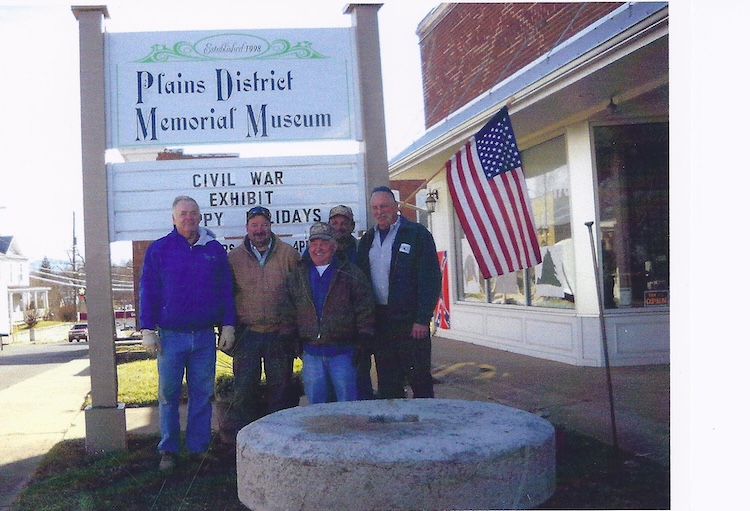
In the fall of 2011, Beverly Arehart and his crew installed the millstone onto its permanent foundation at Plains Museum.
Special programming has been suspended during the current construction at the museum.
NEXT SCHEDULED EVENT
Spring Tea
Limited seating! Reservations will be required.
Happy New Year