























Chimamanda Ngozi Adichie and Dream Count
Born in Nigeria in 1977, Adichie today divides her time between the United States and Nigeria where she grew in a period when memories of the Civil War between Nigeria and Biafra (1967-1970) were still fresh. Adichie became fascinated with its history because both of her grandfathers died in the War. After secondary school, Adichie studied medicine in Nigeria and then came to the US in 1997 where she took a degree in communication and political science from Eastern Connecticut State University (2001). Later she earned M.A. degrees in creative writing from Johns Hopkins University and African Studies from Yale.
In 1998, Adichie’s interest in the Nigeria-Biafra Civil War motivated her to write a play, For Love of Biafra, which she later described as “awfully melodramatic;” however, phenomenal success came when Adichie published her second book about the war, the novel, Half of a Yellow Sun, in 2006. An international best seller, the novel won her numerous prizes, including the prestigious MacArthur Foundation fellowship in 2008. A movie version of Half of a Yellow Sun, filmed in Nigeria, came out in 2013, directed by Nigerian playwright, Biya Bandele. Of the movie, Adiche said, “I like the art of it. It captures Nigeria in a way that’s really beautiful.”
Half of a Yellow Sun features female characters who look to escape the confines of male-dominated society, but her other novels focus more specifically on the cultural limitations women face. Her monograph, “We should all be Feminists” (2014), establishes her credentials as a cultural feminist. She asserts that since world-wide culture has always treated women as inferior, both men and women need redirection to live full lives.
Adichie’s first novel, Purple Hibiscus (2003) presents Kambili, a fifteen-year-old who feels threatened by her extremely religious father. Her third novel Americanah (2013) features a young Nigerian woman, Ifemelu, who, like Adichie herself, is studying in the US and struggling with both her romantic life and understanding existential and race issues in the United States.
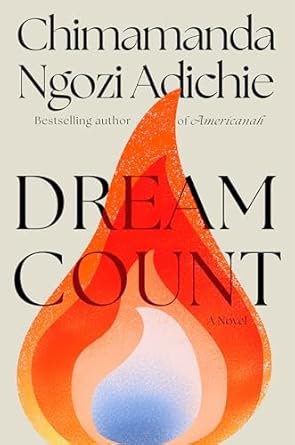
Until Dream Count came out earlier this year, Adichie had not written a novel for ten years. She has said, “I had a number of years in which I was almost existentially frightened that I wouldn’t write again. It was unbearable.” Fortunately, she was able to overcome that trauma. Dream Count tells the story of four Nigerian women, three of whom are living permanently in the US. The fourth, a highly successful banker travels all over the world. In the immediate present of the novel—during the Pandemic—all of the women are in their early forties, but Adichie covers their lives through the preceding decade. All are intelligent and highly motivated, but all struggle with establishing permanent relationships with men. Three of the women are financially secure; the fourth represents the working class.
Although each of the women is important in the novel, Chiamaka, called Chia by her friends, opens and ends the novel. She is s a travel writer who lives permanently in the US. Chia is the most idealistic of the four, believing in the power of love to complete her existence. She says, “I have always longed to be known, truly known, by another human being.” Chia is looking for the proverbial “soul mate,” a man who will understand her completely. In her first narration, she details her attempts to find this perfect lover; no partner passes her ultimate test. Chia also introduces the other three women whose lives Adichie will reveal more fully later.
Chia’s long-time friend, Zikora, a successful Washington, DC lawyer, has her own unhappy love life. Zikora, a devout Roman Catholics, looks to fulfill her dream of marriage and family: “She had always imagined her future in a vivid timeline: first a lucrative and prestigious job, then a splashy Catholic wedding, followed shortly by two children, or maybe three.” In her early 30s, she meets Kwame, who has grown up in the US. She falls in love with him and assumes that he reciprocates her love and that marriage will follow. Wanting a child, she, with Kwame’s knowledge, goes off the pill and becomes pregnant. He immediately—and permanently—abandons her.
Omelogor, Chia’s first cousin, has also achieved great success as an emancipated Liberian banker who makes a huge fortune but still feels emptiness in her life. Knowing that much of her money has evolved from corruption, she gives some of it to needy women in Nigeria, but still, feeling incomplete, she immigrates to the US to pursue a doctoral degree focused on the power of pornography in the modern world. Isolated and unsatisfied in the prestigious university, Omelogor has a serious breakdown and gives up the idea of the doctorate.
The fourth woman in the group, Kadiatou, becomes part of the other women’s lives, first as a housekeeper for Chia. In her own way, she is equally ambitious as the middle-class women, coming to the US on the urging of the man she has loved in Liberia; without her knowledge he is caught selling drugs and goes to prison, leaving her to raise their child. Kadiatou’s story of being raped in the hotel where she works is based on the actual 2011 rape of Nafisssatou Diallo by Dominique Strauss-Kahn, Head of the International Montetary Fund. The interaction of Chia, Zikora, and Omelogor, as they support Kadiatou, gives the novel its strongest focus: Adichie shows the power women can exert when they move beyond self to act collectively.