

















Book Notes: Recent Non-Fiction
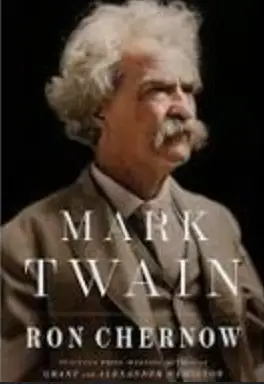
Ron Chernow – Mark Twain (2025)
Basic questions: is a new life-study of Samuel L. Clemens (Mark Twain) really needed? Since Clemens’s death in 1910, more than twenty biographies have been written, beginning with the three-volume set produced by Clemens’s authorized biographer, Albert Bigelow Paine. His Mark Twain: A Biography, The Personal and Literary Life of Samuel Langhorne Clemens came out in 1912. Of later biographies, critics consider Justin Kaplan’s Mr. Clemens and Mark Twain (1966), Fred Kaplan’s The Singular Mark Twain (2003), Ron Powers’s Mark Twain: A Life (2005), and Jerome Loving’s Mark Twain: The Adventures of Samuel Clemons (2010) the best.
With this huge wealth of biographical material, why then did Ron Chernow, the author of biographies of Ulysses Grant and Alexander Hamilton, decide to take on this mammoth study (1174 pages, including bibliography, notes and index)? It came out early this year. In an interview, Chernow said, “Well, this is kind of, I think, the great epic story in American letters. Mark Twain was the largest personality that American literature has produced, and it was really an ideal story because this story has an unusual amount of literary triumph and personal tragedy.”
With the 2010 publication of Mark Twain’s Autobiography, Chernow had access to virtually all primary data available on his subject. Clara Clemons, Mark Twain’s only surviving daughter, deposited all family personal papers, including numerous letters, to the University of California, Berkeley in 1949; Chernow made exhaustive use of this material, as well as of the earlier biographies.
Despite its length, Mark Twain is not a hard book to read. Chernow organized it according to the various stages of Samuel Clemons’s life and, within theses sections, uses short self-contained chapters that enable the reader to make frequent stops and starts; in addition, Chernow makes no attempt at academic analysis. He is telling the story of Samuel Clemens’s life and work, leaving in- depth study to professional critics. His main aim seems to be to capture his subject as both the man (Samuel Langhorne Clemons) and the created persona (Mark Twain.) Many readers identify this public persona as the actual man. In reality, Samuel L. Clemens was an interesting mixture of inflated ego and self-doubt, humor and anger, intelligence and naivety. Chernow declares him a” prototype of the American character.”
The first half of the book—or more—features a sort of stereotypical “rags to the riches” tale of a man born into a fallen family; his parents took pride in their Virginia roots while living in near poverty. None of the Clemens children had more than the basic education provided in the schools of Hannibal, Missouri; however, Samuel Clemons, using his native intelligence, parlayed his skills as a printer, newspaper writer, and steamboat pilot on the Mississippi into phenomenal success. His rise was assisted by his wife, Olivia Langdon, the daughter of a wealthy Buffalo businessman who had made a fortune in coal.
Most significant in Chernow’s study is his attention to the aftermath of Clemens’s success as Mark Twain. Beginning as a Western humorist, travel writer, and platform lecturer, Mark Twain became the “rock star,” stand-up comedian of his era, drawing enormous crowds wherever he performed. In the1890s, after filing for bankruptcy, the Clemons family embarked on world-wide lecture tour that led to their complete downfall. His inept business skills and extravagant spending forced Samuel Clemons to continue his act as Mark Twain. Until his last year, he never gave up offering his profitable and hilarious diatribes, all of which seemed off-the-cuff and unrehearsed when actually memorized.
Chernow provides a rich and fully detailed account of the Clemens family, showing the enduring love between Clemens and his” Livy,” who became his wife, social arbiter, and editor as well as the mother of his four children. Their son Langdon died before the age of two and the three daughters each had extraordinary problems. When the girls were young, their parents gave them every luxury but no practical training on how to live in the real world.
The results were horrific for the daughter as they began to mature. After failing to conform to college life at Barnard, Susie, the eldest, floundered and died, likely both lesbian and anorexic. Clara, the second, an aspiring musician without much talent, suffered from mental illness off-and-on for years. Jean, the youngest, developed uncontrollable epilepsy that her father could not handle. She ended up in institutions when she should have been at home. When Livy died of heart disease in her fifties, Samuel Clemons hired Isabel Lyon as his personal secretary. She fell in love with him but disliked both of the surviving daughters—she was, Chernow asserts, partly, responsible for Jean’s being banished from her home. Clemons’s connection with Lyon ended in completely negativity.
Chernow also deals with Samuel Clemens’s late life fascination with pre-adolescent girls whom he termed his “angel-fish.” He exchanged hundreds of flirtatious letters with them, bought them expensive pins from Tiffany’s, and entertained them in his home, mainly shooting pool with them. Usually, their mothers were on the scene, flattered that this famous writer was taking so much interest in their daughters. Something is clearly “off” here, though Chernow found no evidence that sexual contact occurred between the aging man and his “angel-fish.” In 1961, one of these girls, Dorothy Quick, published a book about their friendship: Enchantment: A Little Girl’s Friendship with Mark Twain. 30 years later, her story became a movie, Mark Twain and Me, with Jason Robards as Mark Twain and Amy Steward at Quick.
If you’re a Mark Twain fan and have time to handle its length, Chernow’s Mark Twain is certainly worth the effort.