





















Book Notes: Recent Non-Fiction
Introducing Ocean Vuong:
On Earth We’re Briefly Gorgeous and The Emperor of Gladness
Though beginning as a poet, Ocean Vuong has written two novels including the recently published, The Emperor of Gladness. Vuong is Vietnamese-American, born in Ho Chi Minh City (then Saigon) in 1988. His grandfather, from Michigan, was a sailor in the US Navy who married a Vietnamese woman. Vuong’s mother was one of their two daughters. This grandfather went on leave during the War and did not return after the Communist takeover.
 With great hardship, Vuong’s grandmother raised her daughters alone. Having married early, his mother, Rose, gave birth to Vuong when she was only 18. She worked as a hair washer, but because of her mixed race, she was illegally employed in post-war Vietnam. After she lost her job, the family fled the country and first lived in a camp in the Philippines; they later immigrated to the United States, where Vuong grew up in Hartford, Connecticut. There, Vuong’s father abandoned the family and never returned. Later in his life, Ocean Vuong did reunite with his maternal grandfather.
At the age of eleven, Vuong was the first in his family to learn to read. The war, having interrupted his mother’s education, left her illiterate in her own language. She never really learned to read or to speak English. Growing up in a household of women, Vuong worked on a tobacco family to help support them. He went to high school at Glastonbury High School in Glastonbury, Connecticut, but says, “I didn’t know how to make use of it.” After high school he first attended Manchester Community College and, briefly, Pace University in New York City before transferring to Brooklyn College where he earned a B.A. in English. Later he earned an M.F.A from New York University.
As a writer, Vuong began as a poet, publishing individual poems in a wide variety of journals. His first full-length-collection, Night Sky with Exit Wounds came out in 2016. His second book of poetry, Time is a Mother, was published after his mother died of breast cancer in 2019. His poetry has won many awards including a poetry fellowship from the Poetry Foundation in 2016. His first novel, On Earth We’re Briefly Gorgeous, (2019), helped him win the prestigious MacArthur Grant that year. After teaching at NYU’s Asian/Pacific/American Institute, Vuong became a tenured Professor of Creative Writing at NYU, a position he continues to hold. Openly and proudly gay, Vuong lives in Northampton, Massachusetts with his partner and half-brother whom he took in after his mother died.
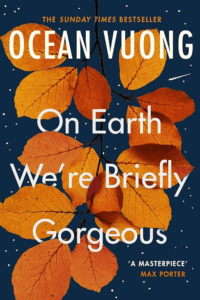
On Earth We’re Briefly Gorgeous, was published to phenomenal success in 2019; It was an immediate New York Times bestseller and stayed on the list for six weeks, receiving many glowing reviews like that of Ron Charles in The Washington Post, who wrote, “Vuong ties the private terrors of supposedly inconsequential people to the larger forces pulsing through America.” The novel is highly autobiographical, belonging to the category of personal writing termed “autofiction,” writing that clearly relates episodes from the author’s life. When asked whether his novel is autofiction, Vuong said, “For me, as a poet, I was always beginning with truth.”
Written as a letter to his mother who cannot read, Vuong’s narrator is Little Dog, now a man is his late twenties. He gave his narrator this name because, in Vietnam, people traditionally gave their children innocuous names to ward off the evil spirits roaming their culture. In this “coming-of-age” novel, Vuong traces the gradual maturation of his young narrator. Raised by his mother and grandmother in poverty-stricken circumstances, Little Dog seeks to understand their troubles and to accept of his own identity as a gay man. The tragic character in the novel is Trevor, Little Dog’s first lover. Being, a farm boy with an engrained sense of rural masculinity, he cannot accept his homosexuality. The title of the novels obviously refers to the transitory quality of beauty and joy in human existence.
The strength of the novel lies in its sincere depiction of what life was like for immigrants from Vietnam who came to the US in the aftermath of the Vietnam War. Vuong has said that, in writing the novel, he was influenced by James Baldwin’s Go Tell It on the Mountain that features another sensitive young artist growing up in an alien environment.
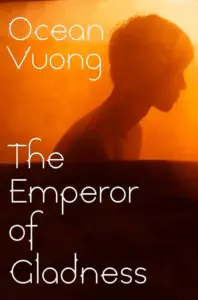 Vuong’s most recent novel, published earlier this year, is The Emperor of Gladness, selected by Oprah Winfree for her Book Club 2.0. Her interview with him reveals his intelligence and sensitivity. This second novel is a more mature work than his first. Another partly autobiographical character, Hai, a twenty-year-old, is on the verge of suicide as the novel opens. Rescued by Grazina, an 82-year-old native of Lithuania, he becomes her caretaker as she struggles with dementia and abandonment by her children. Hai himself suffers from prescription drug dependency and other problems: his illiterate mother thinks he is in medical school in New York City and he continues to mourn the death of his first lover who died of an overdose. Living with the elderly Grazina, Hai ultimately creates two surrogate families, the first with her. Getting a job at a local fast-food restaurant, he becomes part of a second, a group of people living on the edge who yet achieve a sense of community that softens the mechanical quality of their work.
As other reviewers have asserted, in The Emperor of Gladness, Vuong has set out to write a major American novel; the immigrant experience and Hai’s personal problems form the core of his narrative, but Vuong deals with larger American themes including the struggle with poverty, the decline of suburban life, issues of aging, the commercialization of the meat-producing industry, and, even, the legacy of the Civil War. Positive human connection, however, provides the moments of “Gladness” indicated by the novel’s title.