















Larry Brown, 1951-2004
A Remembrance
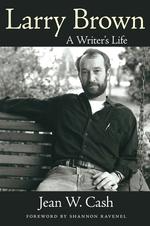
As I recently began a small project on the life and work of Larry Brown, I realized that I have never written a review in The Chronicle about this Mississippi writer, whose biography (published in 2011) I wrote after his death in 2004. Only 53, Brown died of a heart attack on the day before Thanksgiving. This month, then, seems a good time to reminisce about Brown and his work,
I first learned about Brown and his fiction in 1989 at a literary conference in Chattanooga, Tennessee, that my sister, Helen Smith, and I attended. Having just published his first collection of short stories, Facing the Music, he gave a talk titled “A Late Start,” that tells about his difficulties becoming a writer. He also read from his soon to be published first novel, Dirty Work. Impressed with him and the quality of his work, I bought a copy of Facing the Music and had him sign it.
 Before becoming a writer Brown spent 17 years as a fireman in Oxford, Mississippi, where he was born and lived throughout his life. He graduated from high school there just after the draft was reinstated during the Vietnam War. To avoid the infantry, Brown joined the Marines. He avoided being sent Vietnam but during this time, at various bases, he spent much time reading. Influenced by his mother, he had always been a reader but had little interest in school, barely managing to graduate from high school. Released from the Marines after two years, Brown returned to Oxford, married, and, after working at a variety of low-level jobs, he joined the Oxford Fire Department, ultimately achieving the rank of Captain.
When he was 29, Brown decided that he needed to find a profession that would give more meaning for himself and more money for his family. On a “whim,” as his widow says, he decided to become a writer. Over the next eight years, he taught himself how to write, producing four never-published novels and about 100 short stories. He collected hundreds of rejections but refused to give up. His first publication (1982) was “Plant Grownin’ Problems,” published in Easyrider, a biker’s magazine. During the next few years, he published several more stories, but it was his short story, “Facing the Music,” appearing in the Mississippi Review in 1986, that caught the attention of Shannon Ravenel, senior editor at Algonquin Books of Chapel Hill in North Carolina. Her publishing Facing the Music launched his career.
Brown’s importance lies in his emergence as a writer from the working class. Along with others, like Harry Crews, Dorothy Allison, and William Gay, he set out to depict the lives of the Southern poor with authenticity. Their writing has the reality missing from works by more-educated writers who have tried to give empathetic treatment to people who previously could not tell their own stories. Brown, then, was a pioneer in what some critics term “grit lit,” a label that Brown himself did not like. I know because I used it in a first essay I wrote about him for the Dictionary of Literary Biography; Brown removed the term in the advance copy of the essay I sent him.
After Facing the Music, which received positive attention from critics and readers, Larry Brown went on to write another collection of short stories, Big Bad Love (1990); five novels: Dirty Work (1989), Joe (1991), Father and Son (1996), Fay (2000), The Rabbit Factory (2003); and, two works of nonfiction: On Fire (1994) and Billy Ray’s Farm (2001). When he died, he had completed the first-draft of his sixth novel, later edited by Shannon Ravenal and published in 2007 as A Miracle of Catfish. . A complete collection of his short stories, Tiny Love, came out in 2019.
Dirty Work Joe, and Father and Son are the best of his novels. The first novel deals with the lives of two veterans of the Vietnam War who find themselves dying together in a VA hospital in Memphis. Brown later wrote a dramatic version of the novel that Arena Stage in Washington, DC staged in 1994.
 One of Brown’s aims was to see his works become Hollywood movies; he lived to see the central story in Big Bad Love made into film starring Debra Winger; but, as he said, that film was a “flop.” For several years while Brown was still alive, Tim McGraw held an option for rights to make a movie of Father and Son. It didn’t happen. After Brown died, David Gordon Green and three others adapted Brown’s novel Joe into a film, starring Nicholas Cage in the title role. This movie fared a bit better but did not attract much attention.
Father and Son, arguably Brown’s best novel, can be read as a modern counterpart to Faulkner’s The Sound and the Fury. Both novels deal with families riddled with unsolvable problems; the huge distance between them is that the Compsons of Faulkner’s novels are of the upper middle class while Brown’s family is working class. Both writers show that class position does not guarantee successful families.
In 2002, I decided to collect and edit a collection of essays on Brown’s work. He liked the idea and recommended two of his friends as contributors; the University Press of Mississippi published the collection, Larry Brown and the Blue-Collar South in 2007 after Brown’s death. Like other enthusiasts of his work, I was shocked by his too-early death, and almost immediately considered writing his biography. His widow reluctantly supported the project, allowing me to use all of the material—44 boxes—that are at the University of Mississippi. The result was my book, Larry Brown, A Writer’s Life (2011)