












David Wood shared a love of history with his father, Harold Wood. In honor of that connection, David published a series of letters written and received by his father during the elder Mr. Wood’s time in the United States Army Air Corps during World War II.
David describes this venture as a “labor of love”—a task that took over a decade to accomplish. He painstakingly typed the handwritten letters exactly as they were written, preserving their original spelling, grammar, sentence structure, and punctuation. His daughter, Lindsey Wood Lantz also helped with the project, offering ideas and constructive criticism.
He titled the book Chief’s Letters: A World War II Memoir. When I asked him about the title, he explained that his father and two other friends, Tom Miller and Gene Hoover, often referred to each other as “Chief.” David didn’t know the origin of that nickname or its meaning, but it obviously held significance for the three young men.
 The first letter in the collection was to Harold Wood from his friend, Tom. David notes that this letter was part of Victory Mail—also known as V-mail. He explains that V-mail was a special system the United States used during World War II. Instead of sending paper letters (which took up valuable cargo space), people wrote letters on a special standardized form. They then photographed these forms onto microfilm—tiny rolls of film that drastically reduced the mail’s bulk and weight. They shipped the microfilm reels overseas (much lighter than tons of paper mail). Upon arrival, they enlarged the letters and printed them back onto paper for delivery. V-mail saved enormous amounts of space on military planes and ships—one mail sack of microfilm could hold the equivalent of over 30 mail sacks of letters.
Many of the letters give an up-close and personal view into military life during WWII. From rifle ranges to blackouts, gas chamber simulations to local parties, each correspondence tells a piece of history. Harold writes about Thanksgiving “passing like any other day.” And although he says, “They have a big fine looking menu up in the mess hall about the meal that it will be that day,” he concludes with “I’ll have to eat it before I’ll pass my opinion of it.”
The letters also show the anxiety and fear faced by loved ones back at home. Many notes are from Harold’s mother, and she often expresses her doubt that her son will ever return. In one letter she says, “I don’t think I can ever have another moment’s peace…You are so far away and you will never get home.”
Although many people who served in WWII did not make it home—it was cited as the deadliest conflict in history, with an estimated at 50 to 56 million deaths, with an additional 19 to 28 million deaths from war-related disease and famine—Harold’s story had a happy ending. The last letter in the book was written on December 30, 1945. It was short and to the point, but I’m sure his family found it to be the best letter of all. It said, “Dear Poppa, etc. am leaving in next 90 minutes to board the escort carrier.” It ended with, “Will arrive in Los Angeles around 4th or 5th of Jan., Friday or Saturday, I hope.”
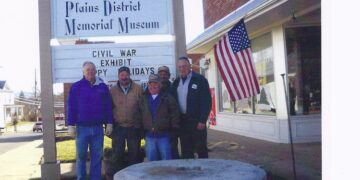
David’s book will be available at J & B’s Country Store, Rocktown Museum, Plains District Memorial Museum, and Fulks Run Grocery. He will be at the Broadway Farmers Market on Saturday September 6 and the Fall Festival Saturday September 13. David will also give a presentation on his father’s war experiences at The Plains Museum on Sunday afternoon, November 9, and at the Rocktown Museum on December 5 at 10:30. He will also have books available at these events.