











William Frederick Rupp, New Market Fresco Painter
Have you heard of William Frederick Rupp? He was born in Germany on January 3, 1834. Rupp did apprenticeships for three years in his native Germany, where he learned “methods of graining, stippling, glass staining, lettering, patternmaking, and frescoing” according to Elmer Smith and John Stewart in Article #21 which was published in Pennsylvania. (The New Market Area Library Archives has many articles by Smith and Stewart written for the Shenandoah Valley Folklife Society including the one on Rupp.)
In 1854, Rupp migrated to America with his father and brother. His brother settled in New York where he became a successful jewelry maker. William came to the Shenandoah Valley of Virginia when he obtained a commission to paint and decorate the Mansion Inn at Luray. By the summer of 1855, he had settled permanently in New Market. Not much is known of his work until after the Civil War. Rader Lutheran Church records show a payment Rupp for painted decorations at the church. Beginning in 1867, Rupp kept a handwritten account book that he continued until his death in early 1900, according to Smith and Stewart.
Rupp was described as “a man of small stature with slim face featuring a black mustache and beard” by Smith and Stewart. In 1862, he married New Market native Mary Catherine Spitzer in 1862. Her ancestors made rifles in the log house that still stands beside Reformation Lutheran Church. Rupp purchased the log house in 1866. A photo of the Rupp House is in the late Phillip Crown’s notebook “Owners of Buildings from today back to 1786” in the New Market Area Library archives which documents buildings on each lot in the Town of New Market.
To make a living, Rupp painted houses (inside and out), barns and outbuildings, tin roofs, wagons, furniture and more. But it is for his skilled artistic work that he is remembered today. His account book shows many familiar local names for whom he did work.
Rupp decorated the halls and parlor of Colonel Pifer’s home in Strasburg in 1868, using “fresco” painting, in which a picture is painted in watercolor on a wall or ceiling on fresh plaster. In early 1869, he was contracted to do fresco in Michael Long’s new home in Page County. In 1870, Rupp did fresco painting in the Methodist Church in Edinburg (he charged $175) which was the beginning of a rise in demand for this style of decoration in churches in the Shenandoah Valley. The United Methodist Church at Hawkinstown visited the Methodist Church in Edinburg and contracted his services for their church. Between 1l870 and 1902, Rupp did fresco painting in 43 Valley churches. He painted decorations in 12 Lutheran Churches (including Mt. Jackson and Timberville locally), 13 Methodist Churches (Edinburg, Harrisonburg, Luray, Woodstock, and New Market), and also was occasionally commissioned to paint by churches in North Carolina, Pennsylvania, and West Virginia. His work in the Shenandoah Valley extended from Roanoke to Winchester.
Other work by Rupp that was in demand was stipple and graining, in which he painted walls to imitate the grain or texture of wood. In his account book, he entered one job as doing “stipple walls, grain woodwork, and fresco the ceiling” (Smith and Stewart). As was typical in the 1800s, Rupp’s payment was often for goods or services (wheat, wood, horseshoeing) according to his books.
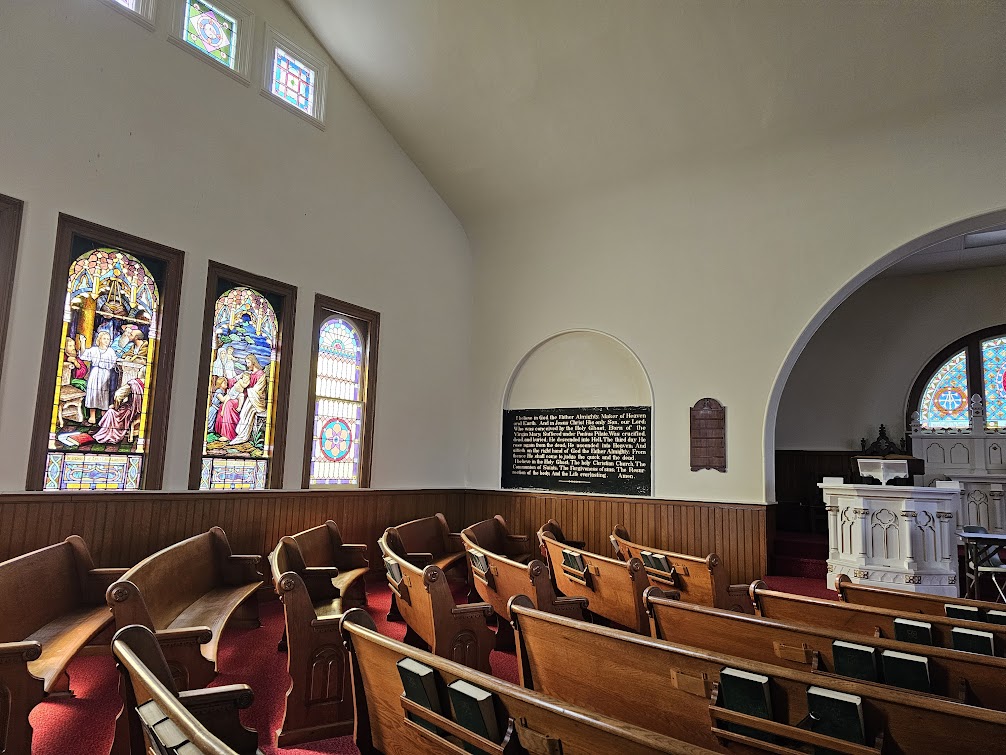
Few examples of Rupp’s work remain today; it was often painted over. However, his fresco work remains on the wall and ceiling of the Henkel House in New Market (first home of the New Market Area Library.) His fresco paintings in Emmanuel Lutheran Church in New Market were unfortunately scraped and painted over when mold was found, according to Bob Moore, a trustee of the Gideon Koiner Trust (established in 1912) which owns the church. The Apostles Creed which Rupp hand lettered in black and gold at the front of Emmanuel is still there. (Emmanuel Church was built by followers of the Rev. Paul Henkel in 1848; it is situated on Lee Street across from the current library; services there were discontinued in 1955 when Reformation opened and Emmanuel was deeded to the Koiner Trust. It is still used occasionally for special services.
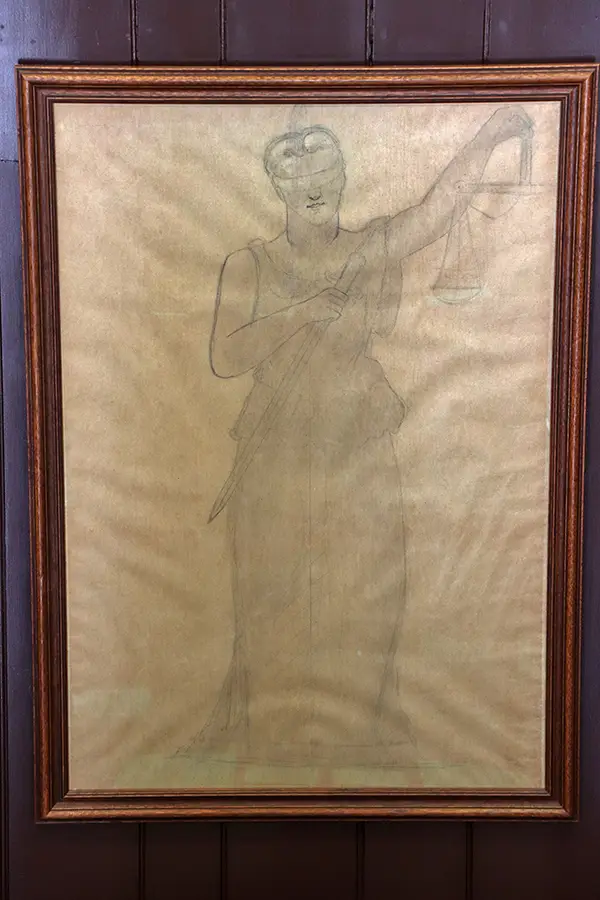
In October 1879, Rupp frescoed the 1871 Court Room in the 1871 Courthouse in Woodstock with a painting of Lady Justice on the wall behind the Judge’s chair; and refreshed the paining in 1900. For many years, a pencil drawing made by Rupp to use for painting Lady Justice, the only evidence of the fresco which was painted over during early reservations. In 2024, the Shenandoah County Historical Society commissioned Paper and Art Conservator Maria Pukownik and her staff to conserve the drawing which is now framed and proudly hung in the original place of the fresco in the Court Room. The Court Room is part of the Shenandoah County Historic Courthouse Museum and is open Friday and Saturday from 11 am to 4 pm, and Sunday from 1 pm to 5 pm from March 1 through December 31 with free admission. Volunteers from the Shenandoah County Historical Society have partnered with Shenandoah County Government to welcome the community and guests to the iconic building, which is the oldest continually used Court House in Virginia, and possible the first two-story courthouse built in the state. Come see Lady Justice and remember William Rupp, famous painter who lived in New Market, Virginia!