















On craft, education, and learning to trust an unconventional path
As soon as I could grasp a tool, Dad put a carving knife in my hand. At two years old I sat in his lap, gripping a wooden mallet and eagerly swinging at a carving gouge he held steady. With patience and instruction, I learned to carve wooden spoons and dough bowls. In the evenings our dining room table and floor were strewn with wood chips and shavings as Dad and I worked side by side. Wood carving was as central to my existence as eating supper. This early exposure hardwired craft into my brain. To my family, it was simply part of being human.
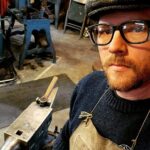
Years later, after finding some success as a professional artist blacksmith, people often comment on my work or ask how I learned—what my education looked like. That question has always struck a sore place in my self-confidence. My education has long been a source of quiet insecurity. To say I took an indirect route would be an understatement.
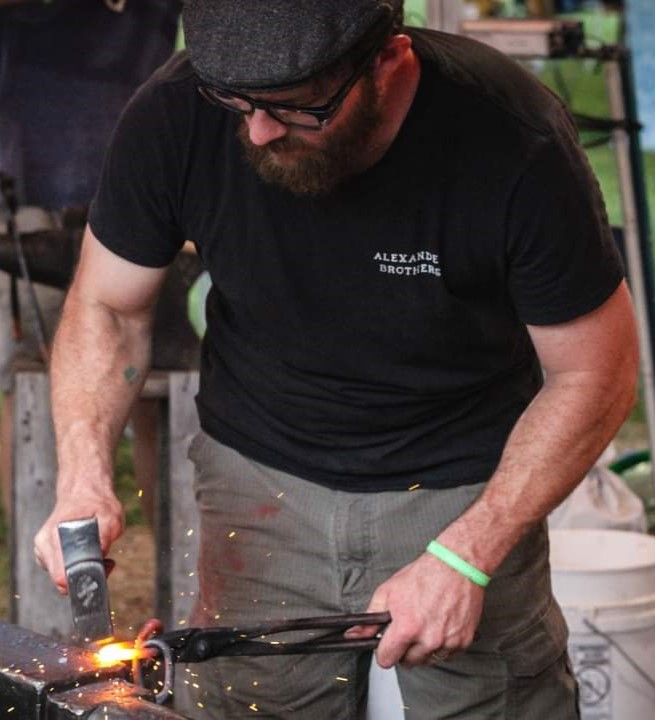
As the oldest of six children, I became the subject of much of my parents’ experimentation—and mistakes—when it came to schooling. I bounced between public, private, and homeschool programs until, finally exasperated, I left school to work full-time after tenth grade. My curiosity and love for learning kept me constantly in motion, often working multiple jobs at once without any obvious goal in mind. I’ve worked at libraries and museums, mowed lawns and stacked hay, cut firewood, operated sewer and drinking water equipment, worked on remodels, sold sheds, farmed vegetables, labored in excavation, worked in a welding shop, and worked on historic restoration and fine home building projects. I attended community college and never finished, choosing instead to study English, art, and business simply for the sake of learning.
None of these experiences relate directly to my current profession. And yet, every one of them was necessary.
My mother played an essential role in nurturing my love of learning. Library days were routine, and books were always within reach. I cannot thank her enough for instilling a love of reading in me at such a young age. I remember poring over my father’s copies of Swedish Carving Techniques by Wille Sundqvist, Country Woodcraft by Drew Langsner, Eric Sloane’s beautifully illustrated reflections on America’s past, and Foxfire Book #5, which first introduced me to blacksmithing.
“Sometimes the slow, winding road is not a detour at all. It may be the most direct route there is.”
My paternal grandfather spent his retirement years holed up in a two-car garage turned woodshop, making toys, baskets, and other wood crafts. When I visited, he kept me entertained by handing me screwdrivers and outdated computers, teaching me the function of each component—the power supply, the hard drive, the circuit boards. One year, for my birthday, he helped me build an AM radio at his dining room table.
And then there was Nana.
My grandmother on my mom’s side was a professional seamstress and craftswoman. For a shiny nickel and a handful of Honey Grams she kept on top of the fridge, she paid me to pick up dropped pins and fabric scraps from her sewing room floor. I can still smell the hot-glue gun, cigarette smoke, and fabric bolts. When I was an early teen and beginning to learn blacksmithing, she let me set my wares beside hers at local festivals. Afterward, I helped pack her pop-up tent, folding tables, quilted vests, and knit caps for the ride home.
Of all the jobs I held, none shaped me more than working for Jay. He took me under his tutelage at fifteen and taught me about historic architecture, millwork, fine home building, and—just as importantly—personal values. He often admonished me to “stick to one bush and pick it clean,” a line he pulled from The Appalachian Photographs of Earl Palmer. That phrase haunted me for years while I bounced from job to job, following my curiosity wherever it led. I felt guilty for not committing to one trade, one clean educational path.
That guilt stayed with me until I met Peter.
Peter Renzetti has been a blacksmithing idol of mine for as long as I’ve swung a hammer. Recently, I had the honor of visiting his home shop to record a long interview with him. To my surprise, his path looked remarkably like my own. With only a high school education, Peter spent years working as a tugboat mechanic, a goldsmith, and in other trades tangential to blacksmithing. At eighty-three years old, he showed me that it isn’t shameful to take time to find your way. Every experience carries lessons. None are wasted.
Spending time with Peter helped me see something I’d resisted for years: sometimes the slow, winding road is not a detour at all. It may be the most direct route there is.
I can say now, with confidence, that I’ve found the work I was put here to do. I am fully invested in my blacksmithing career. Jay would be glad to know that I’ve finally found my trade—and I intend to pick it clean. But at the heart of it, I work for love of craft. To make beautiful things. To offer kindness. To pass along what others so generously gave me.
All of life’s hard times and heart times—its mentors, missteps, and meandering paths—have brought me here. What once felt like uncertainty was, all along, preparation. And yet, I still catch myself wondering if I took too long to get here.