












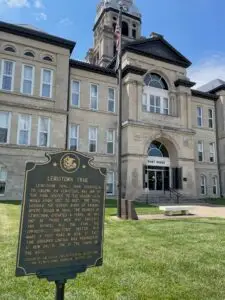
If you descend from any Criders of Brocks Gap, then Jacob and Magdalene Waggoner Crider are your ancestors. In August, we were privileged to visit Lewistown in Fulton Co, Illinois, where Jacob & Magdalene moved in 1853 along with one of their sons, Christian. All their other children stayed in Virginia.
Jacob received 80 acres of land northwest of Lewistown in Section 18 because of his service in the War of 1812.. His son Christian Krider (yes, Christian changed the name spelling) inherited the farm when Jacob died, and you can see Christian’s name on some of the township maps.
Jacob, Magdalene, Christian, and Christian’s wife Hannah are buried on the family farm, but they have a memorial stone in the very large cemetery in town called Oak Hill. You can see from the tombstone that Jacob and wife lived to very old ages. A Crider descendant who grew up in Lewistown told me that their original stones on the farm were broken and probably have been discarded.
We drove out to the farm (no buildings left from the Crider years, though) just to see what the land looked like. “Big Creek” flows through part of it, and the farm is located on Rabbit Run Road. The modern house on the property was built on a small hill. However, there is a beautiful, large, flat field (of tall corn) to the left of the house which I think was part of Jacob’s farm. Judging by the size of the present corn crop, he received a good section with fertile soil. We wondered what the family thought of the difference between their mountain farm on Shaver Mountain at Criders, Virginia and their new home of practically flat farm land in Illinois. Did they miss the mountains? Did they ever visit Virginia after moving?
 Jacob Crider may have been in a “strange land” but he was not totally among strangers. It appears that some Lewistown neighbors were also from Brocks Gap. In 1855 while living in Illinois, Jacob applied for a second tract of bounty land based on his volunteer service in the war. John CAPLINGER witnessed the application. Caplinger’s 1850 census record says John was born in VA but his 10 year old son was born in Illinois, making the family a very early pioneer to Illinois. Jacob’s will was witnessed by John SIEVER. John may have been a son of Solomon SIEVER who was originally from Brocks Gap but moved to Fulton Co., IL and is buried about 15 miles from Lewistown.
Jacob’s War of 1812 service records have some interesting facts. He was drafted in July 1814 for a term of six months. His pay as a drafted private was $8 per month. His first pay packet (for two months) deducted $1.50 for clothing. What kind of uniform did he receive? The June 8, 2012 Massanutten Musings published by Massanutten Regional Library, stated that “The men who were called-up marched, often 25 miles a day, to Richmond, Norfolk, and Maryland – any place within a short distance of the Chesapeake Bay and its tributaries – to fulfill their service. Recruits arrived at their destination often wearing unbleached, tow-linen shirts and trousers. Their hats were low-crowned and had a black cockade on the left side. Soldiers carried a tomahawk, a knife, a cartridge box, a bayonet, and a quart-size canteen. Complaints from military officers forced the Virginia Governor to try to upgrade the dress code, but, in fact, most militia men went to war in everyday clothes.”
When Jacob was discharged in December 1814, he was allowed pay for between 3 to 10 days to travel home since the distance was between 60 and 200 miles. He would have walked all the way home to the Gap from Charles City, Virginia, the seat of Charles City County located about halfway between Williamsburg and Richmond.
Another note in Jacob’s service record said that he was detailed (or assigned) to wait on the sick home [hospital] as part of his service. After his draft service was completed, he volunteered at Camp Mitchell near Richmond.
In addition to his bounty land, in his later years Jacob received an $8 monthly pension for his war service.
The Criders may have known local Illinois lawyer Abraham Lincoln who gave a famous speech in Lewistown in 1858 when campaigning for U. S. Senate. They also were connected with the Ross family, whose head Ossian Ross founded Lewistown. In 1855, Ossian’s son Leonard Ross testified in Jacob’s bounty land application that he personally knew Jacob Crider.
From war veteran to mountain farmer to prairie farmer, hard-working pioneers like the Criders helped make the United States strong.