











What’s In a Name? Mauzy (mow ZEE’), Sparta, Spartapolis?
In February 2023, the Chimney Rock Chronicle printed my article about the demolition of the Inn at Mauzy! The Alliance for the Shenandoah Valley found the article in searching for history of Mauzy and asked me to give a short talk on the history of Mauzy for their special celebration near Mauzy in honor of the late Juanita Burtner, 2025 North Star, as well as Dee Dee Sellers and Tim Murray, 2025 Valley Treasures Award! So, I researched Mauzy’s history.
What roads lead to Mauzy? The current Route 11 has a long history as a road; it was an early buffalo trail. Next, Route 11 was a native American path; it originally veered left after Tenth Legion and continued along the present Indian Trail Road towards Keezletown. Next, it was called the Great Wagon Road when it was a stagecoach route. One reference called it The Long Gray Road. Between 1834-38, it became a turnpike called “Valley Turnpike.” It had tollgates about every 5 miles; one was south of Mt. Jackson at the bridge, one on the south end of New Market near where Southern Kitchen stands today, another ½ mile north of Tenth Legion. All toll gates were removed in 1918 when the state took over the road and gave it the designation of Route 11. In 1932, Route 11 was rebuilt and moved to the southeast, avoiding the Inn and other historic buildings. The Cross Valley Road (Route 259 today) came through Brocks Gap through Broadway and in early days intersected Valley Pike south of the Inn at Mauzy. Interstate 81 was built in the early 1960s; it split the farm at Mauzy, but the road made a wide sweeping curve to avoid the historic buildings there.
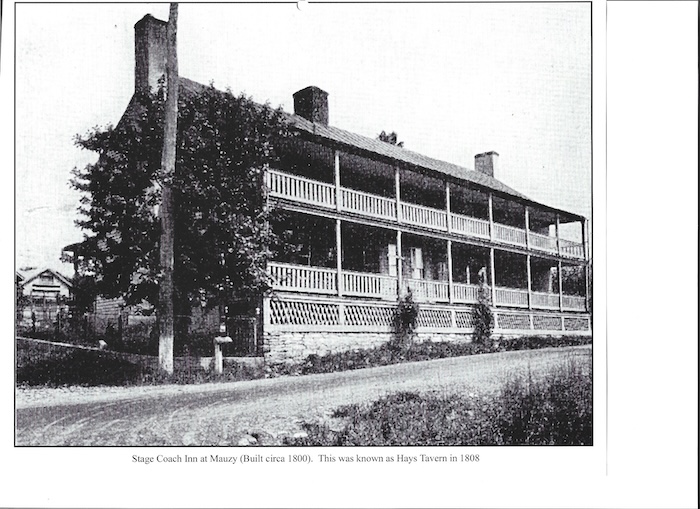
Mauzy is located midway between Tenth Legion and Lacey Spring in Rockingham County, VA. A post office was established here in 1880. Until 2023, an old large house, originally an inn/tavern (ordinary) which provided lodging, meals, and stable arrangements for the stagecoach horses stood at the intersection of Route 11 and Route 259 at Mauzy. The inn had various names over the years: Hayes (or Hoys) Tavern, Stagecoach Inn, Inn at Mauzy.
Some of the owners of the land and operators of the store at Mauzy before the 1844 were Jacob Woodley, William Pickering, Derrick Pennybacker, Richard Pickering. Prior to the Civil War, the site was used for musters and political rallies; during the Civil War it was an army enlistment place.
In 1832, Richard Pickering submitted a petition to the General Assembly to establish the town of Sparta, which was signed by 100 citizens and mentioned a crossroad and readily available water were in place. It was called Sparta for awhile but a town in Caroline County had the Sparta name and mail often got sent to the wrong place. The Mauzy name came in when Pennybacker sold the store business to Jacob Mauzy and Madison Brown. Mauzy started operating the store in 1848 (on the east side of Valley Pike.) Joseph Mauzy bought land from Pickering in 1845 and 1847.
In 1845, Pickering had submitted another petition to change the name of the town to Spartapolis.
In 1858, Colonel Emanuel Sipe bought the store business at Mauzy. Besides running the store, he was a Lt. Col. In the Virginia militia. In 1862, he enlisted as a Captain in the 12th Virginia Cavalry. In 1865, Sipe was commander of the 7th Virginia Cavalry and was captured and taken to Delaware as a POW. After the war, he reopened the store at Mauzy and stores in Linville and Pendleton County, WV.
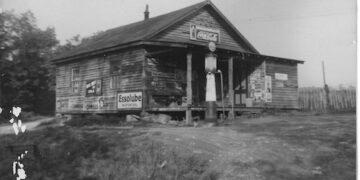
In 1866, Jed Hotchkiss (Stonewall Jackson’s mapmaker) identified the crossroads at Spartaopolis as Sparta. It had ten buildings around the house. However, the Lake’s Atlas of Rockingham County labels the crossroads as “Mauzy Post Office” and showed only 3 buildings along with “J.B.D. Rhodes Store and PO.” In 1886, David Blakemore operated the store (which was across the road from the later store.) It burned down on Feb. 25, 1886. In 1894, the store business was sold to J. K. Mauzy and Son. In March 1919, Joseph Mauzy sold inventory to Lacey Spring Postmaster David Taylor.
Local historian Dale MacAllister wrote a 70-page unpublished paper for Sylvia Crumpacker when she owned the Inn and ran the Shoppes at Mauzy. He describes the Inn in great detail and also notes that the Virginia Department of Historical Resources had surveyed the Inn.
The Mauzy family descends from French Huguenot preacher Henry Mauzy who fled France in 1685. He moved to England, then came to America (South Carolina then Stafford County.) There is a Mauzy cemetery near Mauzy, and Mauzy slaves are said to be buried on the part of the farm behind the Derrow house on Mauzy Athlone Road.
The current road from the Valley Pike (Route 11) to Mountain Valley Road (Route 620), is called Mauzy Athlone Road (608). The post office for Athlone was located at the intersection of the current Mauzy Athlone Road and Mountain Valley Road. Tradition says that Athlone was named by the Speck family who moved to the area in the 1870s after their hometown in Athlone, Ireland. There was another post office named Oakwood in Mountain Valley (at the intersection of the current Martz Road, 806, and Mountain
Mountain Valley (not to be confused with Singers Glen which was once called Mountain Valley) is the area between the intersection of current Martz Road (Rt. 806) and Mountain Valley Road (Rt. 620), had a post office named Oakwood. Of the four post offices mentioned, only Lacey Spring survives today.