

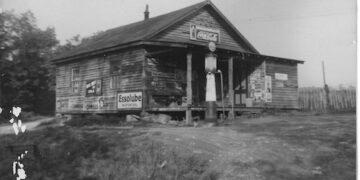



First, my apologies to Ronnie Fulk for an omission in last month’s column about the businesses at the former Crider Brothers store. After Charlie and Loy Crider retired, Ronnie and his father Matthew Fulk operated M & R. Feed & Hardware, selling animal feed plus a large inventory of hardware. The next business was Biedler Fulk’s Valleyland Opry House, complete with a stage and seating in the basement. Next Diana and Tommy Cooper ran Valleyland, with merchandise, a small restaurant, and new tire sales from the basement. Currently Twice as Nice Thrift Shop operates from the building.
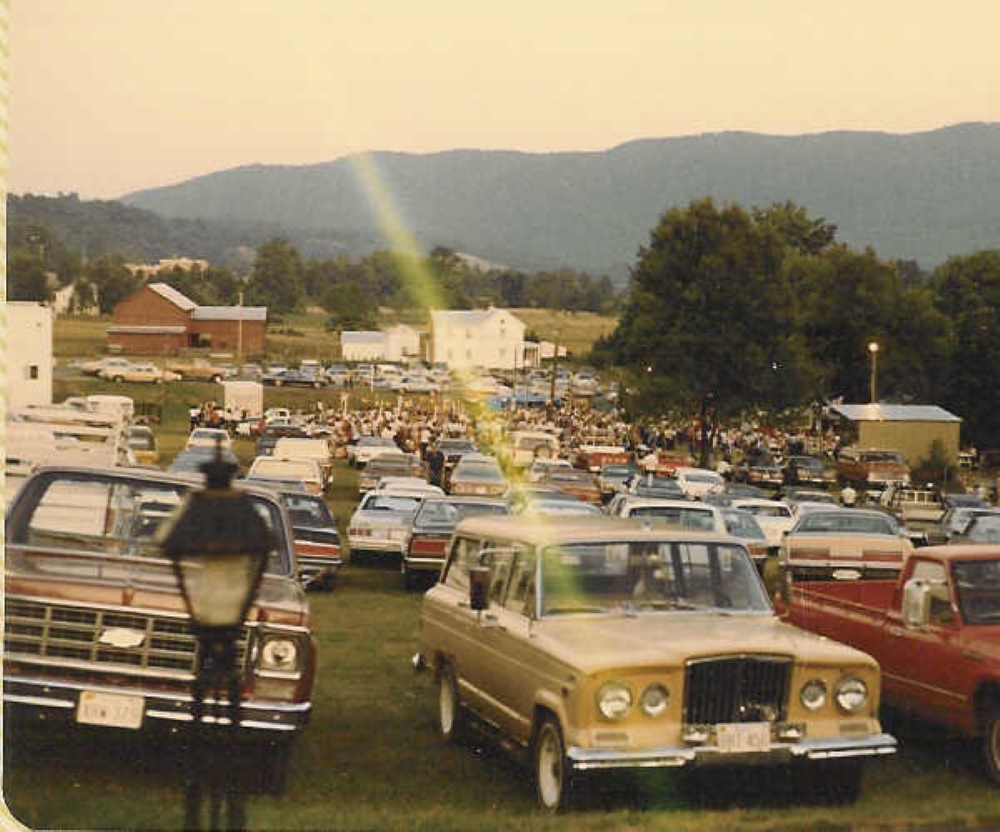
The Fulks Run Ruritan Lawn Party will always be THE Lawn Party to me. For over 25 years, it was literally held on my parents’ lawn, behind Fulks Run Grocery, starting July 18, 1958. I was only six years old at the time, but I remember that the club borrowed some stands from other organizations and built new stands. Currently, the cake wheel stand still uses boards and supports of the original design. I remember Garland Reedy, Jim Custer, Lloyd Turner, and others putting the stands together. Hettie Mongold made hamburger patties by hand in the store basement, changing a round ball of meat into a flat patty with a pressing device.
Local musicians like Charles B. “Cookus” Shoemaker, his daughter Repha Reedy, Harrison Fulk, and others provided entertainment. They performed on a farm wagon parked in the old road which is now the lane to Turner Ham House. Two wide boards made a gangplank from the bank to the wagon.
Cake walks were my favorite thing. In the Ruritan’s 50th anniversary history by Chris Bolgiano, Larry Custer described the cake walks: “For the cake walk, you paid your dime, and got in a circle, and there was a board. There might be thirty, forty, fifty people, it’d be a big circle, and the person that was stepping on that board when the music stopped won the cake. Cookus played fiddle…and he’d stand with his back to the board so he couldn’t see who was on it. He’d be a fiddling away and then he’d go whomp! Whenever he stopped, he’d stomp his foot. And whoever was standing on the board would win [a homemade cake]. Or was within stepping distance, whoever was closest. If they got too big a bunch they’d have two boards and give away two cakes at a time.” I remember Andrew Thomas collected the dimes in a cigar box, and my dad Garnett Turner stood at the board to signify the winner. Ha, a couple times one of Garnett’s children should have been the winner, but he’d push us off the board & grab the next person so that it didn’t look like he was playing favorites.
For girls, it was an honor to become strong enough to carry the cake walk cakes through the crowd to the band wagon. We walked the plank and stood on the band wagon holding a cake during the cake walk, then we’d present it to the winner. All were layer cakes, not sheet cakes. This was before clear plastic wrap; the cake plate was cardboard covered in aluminum foil with the cake on top. We had to be very careful not to drop or tilt them. One year Debbie Wittig, my sister Norma and I helped with a cake raffle. We carried a cake through the crowd, offering chances at 25 cents each. When our numbered sheet was full of names, someone at the band wagon drew the winner’s name.
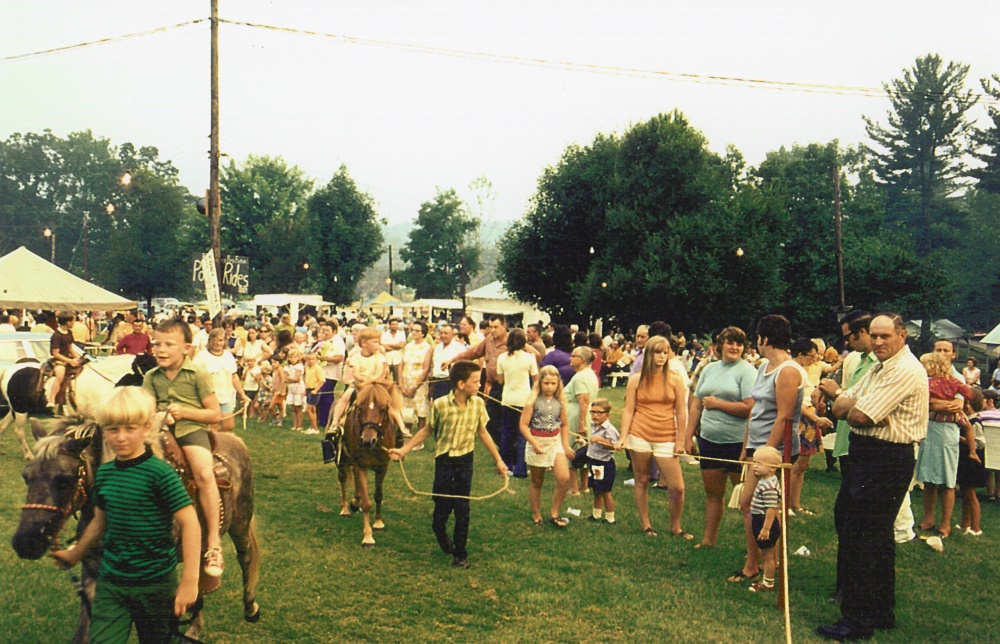
My uncle Granvil Turner furnished pony rides for 25 cents. His ponies were hitched to a pony ring and walked in a circle. Those rides were very popular. One or so years there were donkey rides as well.
Food was simple at the first Lawn Parties. Fried chicken by Hilda Mitchell, Ruth Wilkins Detra and Pauline Fulk, and hamburgers and hot dogs by Hettie Mongold, Bill and Ethel Miller, and others. They kept bottles of pop cold in big vats like scalding troughs, Robert Mitchell recalled in the club’s 50th history.
Jim Custer remembered making homemade ice cream, “That was right smart of an afternoon job; it took a lot of cranking to make ice cream for that evening.” Robert Mitchell added that it was a big seller.
Join us at THE Lawn Party this year, July 24-26 for good food, entertainment, and support of community. Even better, volunteer at one of the stands to get the full benefit of community participation. As the late Robert Mitchell said, “You feel good because you’re helping out people here in the community, helping do something that amounts to something; you can see the results of it.”