






















“I don’t like that song at all. Of course, somebody spent a lot of money recording that song, so we felt like we should play it.”
“That song’s sure too rocky for me. But they told me I have to play it”.
Can you imagine me saying either of those on-the-air at WBTX?
“I’ve actually heard such comments as these on the radio in my travels within the past few months,” wrote Paul Heil in Singing News Magazine in April of 1989.
Paul Heil produced and hosted the popular The Gospel Greats radio program for over 40 years and quickly became a well-respected figure amongst the southern gospel community. Beginning in the late 1980s, he wrote a monthly column in Singing News Magazine entitled “Radio Forum”, focusing on some of the challenges facing southern gospel radio stations at the time.
“Imagine tuning in to your local southern gospel radio station. You like the music, but the DJ just doesn’t seem to be all that interested,” Heil wrote. “Your enthusiasm for the guy is totally gone, you reluctantly tune away from the only southern gospel station to, let’s say, your local country station, where the music may not be so much what you want but they sure do sound like they enjoy what they’re doing”.
This month will mark my 8-year anniversary at WBTX, and I’ll admit, it can be very difficult to hire a “southern gospel” DJ. The “pool” is very small, especially considering how southern gospel is such a “niche” genre. You may find someone who “eats, sleeps, and breathes” southern gospel, but lacks effective communication skills…or someone who has years of experience in radio but cannot “adapt” to the southern gospel format.
Before I go any further, I’ll issue this “disclaimer”. Keep in mind that, before I began working at WBTX, I knew NOTHING about southern gospel music, and had absolutely no “professional” radio experience. I’m entirely “self-taught”, you could say.
Creating an effective southern gospel DJ requires initiative on the part of the DJ, and the company itself. The DJ needs to be willing to learn, and the company needs to provide the adequate resources to enable that DJ to learn and grow.
I’ve mentioned before that one of the “keys” to successful southern gospel radio is the sense that the DJ not only knows the music but also enjoys the music. Sure, you can “fake” some things on-air, but a lack of enthusiasm for and/or knowledge of the music will (even inadvertently) become apparent to listeners.
In a brochure made available to radio stations around 1990, Heil added, “do not do a southern gospel program if you know less than most of your listeners about the music. Your lack of knowledge will be apparent to your audience.”
As a program director, I cannot expect any new hire to become a southern gospel “encyclopedia” overnight. I have to provide that person with the tools to enable them to learn more about the music. Our current “freeform” format supports this: I encourage DJs to play different songs each and every day, giving them the freedom to explore our vast library of recordings. I dissuade them from trying to play only the “latest and greatest” in southern gospel (i.e. a “Top 40” format), or falling into the “trap” of playing only their favorite songs.
My “secret”? Index cards.
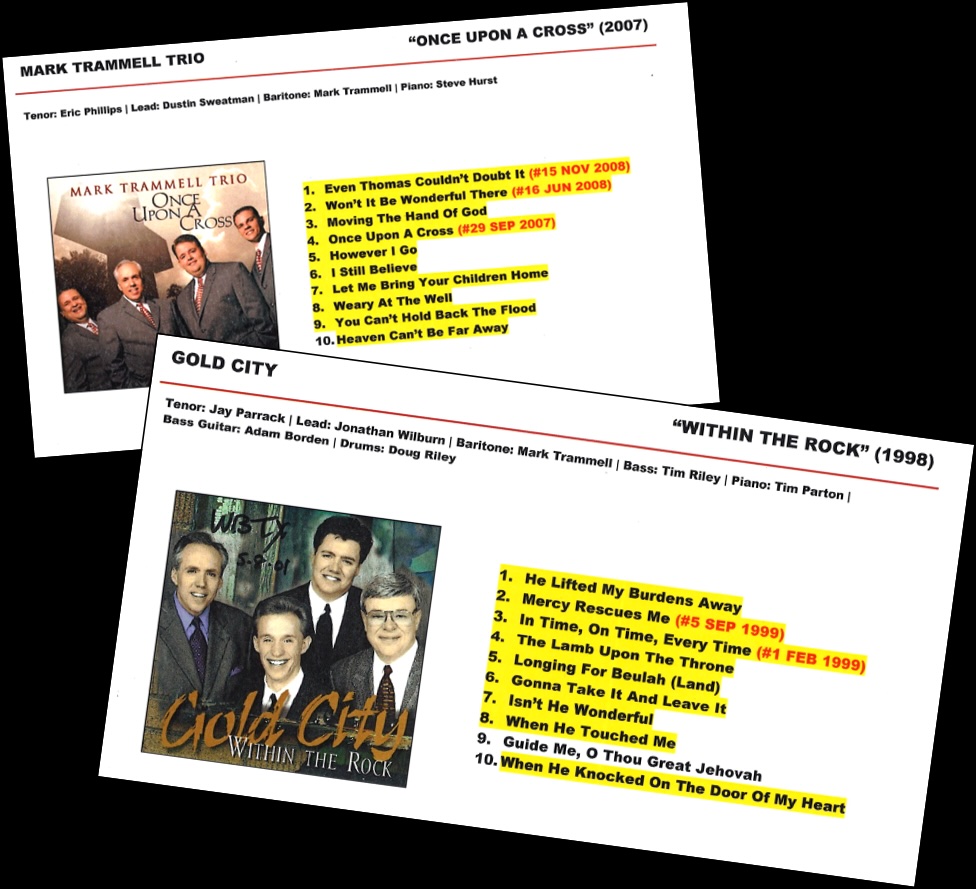
This is actually something that was in place at WBTX for many years; I brought it back after it being “retired” for 7-8 years. In the studio are two bins filled with cards, one marked “2004 & Older”, the other “2005 & Newer”. The cards do not contain individual songs, but rather, entire CDs/albums. The DJ pulls a card from either bin (their choice), and immediately has their choice of 4, 5, 6 (or even more) songs from any given CD. What’s more, this card also features a picture of the CD, a listing of the group members, and chart information (i.e. #1 songs).
This is a fun way to select songs, while at the same time familiarizing the DJ with the various groups. Plus, it isn’t just for “newbies” – I use it each and every day! It eases the “challenge” of picking songs each day and also prompts me to play groups that I feel I sometimes inadvertently overlook.
So, that’s my “secret” to teaching new hires about southern gospel music. But again, that’s just my part – becoming an effective southern gospel DJ also requires initiative on the part of the DJ to want to learn and be willing to learn. I like to tell DJ’s, “If you’re not having fun, you’re not doing something right”. Paul Heil put it a bit more bluntly, “If you don’t like what you’re doing…get another job – one you’ll enjoy.”